

Peter Diem
Audience Research in Austria: History, Design and Recent Research Eindings
Abstract
Although early audience research in Austria was facilitated by innovative con-tributions of social scientists such as Paul Lazarfeld, it was not until the 1980s that the discipline received considered attention by the broadcasting in-dustry. Since then, major inroads have been made in perfecting methods for data collection and analysis, and in reporting findings to clients. Various tech-niques have led to a degree of standardization and have served as a model for other research institutions. These and current concerns with advances in new interactive media are sketched in this article.
Early Days
Radio was established in Austria in 1924 and television introduced in 1955. As early as 1932 the Viennese social scientist Paul Lazarsfeld was asked by RAVAG, the Austrian Radio Corporation, to conduct a nationwide survey on public attitudes towards the new medium. Lazarsfeld collected and evaluated no less than 110,000 questionnaires about radio listening during this period. Some ten years later he gained early recognition in his career through devel-opment and application of a ‚Program Analyzer‘, a measurement tool incor-porating a moving length of paper on which green and red fountain pens were used to record positive or negative audience reactions.
Due to the forced emigration of Jewish and other anti-Nazi intellectuals and the conditions of World War II and its aftermath, it was difficult reinstituting empirically-based media research in the country where much original work had previously been performed. Although radio research was initiated as early as 1947 in neighboring Czechoslovakia with the assistance of BBC specialists, it was not until the end of the 1970s that the monopoly Austrian broadcaster ORF introduced systematic audience research. When I was asked in 1980 by Gerd Ba-cher, then Director General of ORF, to build an audience research department, I was only able to consult a handful of reports produced in preceding years.
For television viewing, some rating studies had been conducted, mostly on an ad hoc basis through face-to-face interviews regarding programming on the two national channels. For radio, the ORF had relied mainly on multiple media studies conducted by the publisher-dominated Verein Media-Analysen. So, my first assignment was to visit Western European broadcasting organiza-tions in order to become acquainted with the state of the art‘. Dutch collea-gues in Hilversum, in particular Harold de Beck who was then director of the audience research division of the NOS, gave much professional ‚development aid to Austria. The result, among other things, was introduction of a televi sion diary system which was used for a full decade from 1981 to 1991.
Current Situation
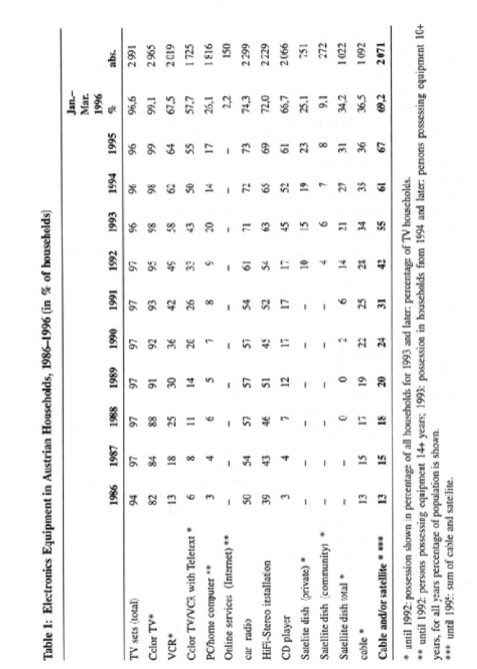
Much development occurred in the subsequent 15 years, but this is passed over in order to describe what ORF audience research presently does. First, it is important to realize that Austria represents a relatively small market with only 6.6 million residents 12 years and older living in 3 million households. Given the mountainous terrain of the country, some 1,570 transmitters were built and maintained by the ORF, the national public service broadcaster ORF transmits 48 hours of television programming on two channels and 170 hours of radio programs on 12 channels per day. ORF has a permanent staff of 3,200 which is assisted by some 200 free lancers. The overall budget of the station is roughly USD 1 billion of which about 46% is earned through adver-tising on television and radio. Although the ORF is the only station allowed to broadcast television from Austrian territory, 69% of the population can also receive an average of 23 German language television programs from neigh boring countries. This is made possible through cable television networks (penetration 34%), home satellite antennas (pesetration 35%), and over-the-air reception along the border region with Germany (accounting for about 12% of TU households). See Table 1. Regarding radio, private national competition began recently in Styria and Salzburg, two of Austria’s nine provinces. Addi-tional private radio enterprises are scheduled to be introduced next year.
The ORF Audience Research Department has seven full-time positions, half a dozen freelance assistants and an annual budget of just above USD 6 million of which more than USD 5 million is earmarked for television re-search. The Department is a unit of the Director General’s office Generalin-tendanz/Medienforschung (GMF). The present ORF management, Director General Gerhard Zeiler and Secretary General Andreas Rudas, has entrusted the Department with a number of far-reaching innovations, including doubling the sample size of the television meter panel (from 600 to 1200 homes), intro-ducing a new television meter and software (Telecontrol XL and PC#TV), supplementing the station-wide mainframe-based management information system by a Windows NT server system, continuous pretesting of new pro-grams and last but not leasta complete restructuring of radio research.
GMF Philosophy
Five principles guide ORF/GMF activities, the first of which is outsourcing. From the beginning of research activities in 1980, organizational, economic and methodological considerations made clear that fieldwork and data analysis
should be entrusted to private institutions. This policy enables the small academi-cally-trained staff of GMF (four persons concerned with television and one with radio) to prepare briefings and maintain quality control of the research operation. It also enables the small staff to concentrate on practically-oriented research find-ings and on the transfer of this information to program makers and advertizers.
The second principle guiding ORF/GMF is pragmatism. At a very early stage, prompted by Gerhard Weis (now ORF’s Radio Director), we learned to understand that an audience research departmen intended to serve broadcas ters must not function as an ivory tower. Complicated academic considera-tions, endless discussions about theoretical foundations and methodological purity were ruled out from the very beginning. Research has to serve the prac tical purposes of program makers working under strict deadlines and manage-ment needing factual overviews all with the intent of securing high audience acceptance of programming without sacrifice in quality.
The third basic element in the Department’s philosophy is a combination of rapid delivery of findings in an easy-to-read format. First of all, we ensure re-search is conducted and results delivered with maximum speed. A report on al focus group, for example, is expected within a single day; in more complex si-tuations no more than half a week is granted for completion of an evaluation. Reports based on multi-client telephone research (N = 1000) including tables and graphic display of the main findings, are produced within 10 days. The De-partment has made it standard practice to present summaries of its reports in brief, attractive formats facilitating their reading and comprehension. Such fact sheets and other short documents are presently stored in a databank so they can be easily and quickly provided to station personnel. Most data transmission to management transpires via an internal email system.
The fourth principle is international cooperation. We are particularly inter-ested in the insights and approaches of our audience research colleagues else-where in Europe. Both the ideas of those committed to public service broad-casting such as our Scandinavian colleagues as well as those from commer-cially-oriented researchers are of interest to us.
The final principle to be mentioned here is harmonization and labeling. When we have perfected a method ourselves or learned about it elsewhere we consider it for further applications. An example of this principle is the ‚Ac ceptance Index‘, a measurement of attitudes on a scale running from 0 to 10 (10 representing maximum acceptance or appreciation). First introduced in re-lation to music testing, the scale is now being used for television program pre-testing, program host research and other applications. Labeling refers to for-mulation of easy-to-remember names of our products. In this manner, television meter research in Austria has come to be known as Teletest, the standard radio measurement system is called Radiotest, music research is per-formed with the Phonotest and videotaped focus groups are referred to as Vi-deotests. Our mainframe-based management information tool is called Taps and its more recent PC-based ’sister‘ has been baptized as Tips.
Television Research
Hardware and Panel Design
As in most Western countries, the backbone of television research in Austria is a meter panel. The Austrian Teletest was instituted in 1991 with 600 homes using the Swiss system Telecontrol VI with special software adapted for ORF requirements. Presently, the panel is about to reach its maximum size of 1200 homes; Telecontrol XL is being installed in all new panel households and in some of the others. Originally, two types of remote controls were offered by producers of the XL version of the hardware: a very simple unit and a more complex device. Together with Fessel+Gfk and Ifes, the institutions entrusted with running the meter panel in Austria, we developed a third remote control device which is more user-friendly. The handset combines appreciation but-tons with the teletext buttons. Telecontrol XL is a tuner meter which means that a black box sitting below the television set contains a number of tuners. which convert the set itself into a mere monitor. In this manner, present and future developments in the field of signal transmission (digital, encrypted, pay television, etc.) can be handled. The XL not only identifies a channel by its frequency, but also by its VPS code (video programming code) for added ac-curacy. It also scans the total frequency range, which results in a complete re-ception pattern on location.
On top of the television set is a small display which, when the set is switched on, asks for registration of viewers and of appreciation scores to wards the end of programs (‚free appreciation‘ or non-prompted program eva-luation). There is provision for data from up to eight family members and an additional eight guests. Several times a day a reminder message is down-loaded to the panel requesting them to press their buttons as they enter or leave the room. The panel is recruited following strict probability procedures, with an annual rotation of around 15%. Panel member incentive is stimulated with a quarterly check of ATS 500 per family and with opportunity to partici-pate in various lotteries.
Software and Evaluation
The meters are read daily and the results consolidated with the ORF program log each morning. In this manner, ‚overnights‘ are transmitted to the ORF mainframe computer at around 9:30 a. m. on a daily basis. The ratings of the leading German television programs are also available every morning. While program ratings and appreciation indexes as well as daytime shares are commu-nicated automatically to about a thousand screens in the company, teletext tables with ratings and shares are generated and transmitted for the benefit of advertisers, journalists and the general public. The data are then further pro-cessed by GMF to provide email overviews (synopsis Excel sheets) for man-agement. Through this highly automated data dissemination procedure it is pos-sible to furnish program makers and management with detailed information on program performance by noon of the day after the programming was aired. The compiled information includes:
viewing time, net audience reach and share of major stations for the entire preceding day;
program and part-of-day shares across the nation and for multichannel homes (which account for 69% of Austrian households);
main demographics such as age, education and region;
average age of audience members for every program;
daily hit lists of ORF and competing programs;
net reach and fidelity index (rating/net reach x 100) of all programs;
appreciation score (6-point scale) for ORF and all other programs;
economic program performance score (program costs divided by program
duration, resulting in cost/minute per 1000 viewers;
minute by minute indication of viewer movements allowing programmers to see when viewers enter and leave ORF programs.
In the course of the week the above data are supplemented with repeated poll-ing of panel homes, and the results are presented in the form of weekly re-ports which include prevailing average daily temperatures (weighted with the population of the ten meteorological regions). These weekly data are then stored in a data bank on the Department’s server from where the final graphic output can be derived.
These daily and weekly reports constitute input for more longer-term as-sessments produced monthly, quarterly, and annually. These documents are not only for the benefit of program makers and management, but also in mod-ified form for the advertising industry. Advertisers receive monthly average block ratings free of charge and are encouraged to make use of an extensive analysis system offered by Fessel+GfK. This service comprises various kinds of campaign evaluations, ratings prediction models and target group calcula-tions. The latter may be evaluated on the basis of more than 200 different con-sumer groups from those purchasing either carned or fresh cat food to those viewers intending to purchase a second hand car
Qualitative Aspects of TV-Research
Appreciation Measurement by Meter. In general, there are two basic ap-proaches to practically-oriented qualitative television research. One is based on data from an appreciation scale as collected in meter, diary or phone pro-gram studies; the other entails use of in-depth interviews, focus groups, la-boratory experiments or auditorium tests for data collection. ORF/GMF makes extensive use of both approaches. Austria is, of course, not the only country which runs a meter system with program appreciation. Similar proce-dures are also followed in Belgium, Denmark, Finland, The Netherlands, Nor way, Portugal, Spain and Switzerland. While in England a supplementary ap-preciation diary is used which renders appreciation indices for all programs, it is interesting to note that the three major markets of Germany, France and Italy employ no similar system. Countries relying on diary-collected data,
such as the Czech Republic and Slovakia, in most cases also include an appre ciation measure.
There is no simple correlation between ratings and appreciation. Large audiences are by no means always satisfied audiences. Large audiences are, in most cases, composite audiences, meaning that a considerable number of viewers are sitting before the screen without really having personally chosen to watch this particular program. And sometimes it even seems that viewers almost hate what they see. This is not only the case when the national soccer team suffers a painful loss against an ‚inferior‘ opponent or when ski cham-pions miss a victory by milliseconds. There are also other instances in which rather large audiences may react with disgust. For example, news programs. with violent pictures from a theater of war, or discussion programs on unpop-ular subjects are of this type. In many instances, low appreciation may com-bine with high ratings. Of course the opposite is also possible: low apprecia-tion combined with low ratings Here, a minority program may not have. found enough satisfied viewers within the minority audience concerned. This occurs quite often with programs on modern art or contemporary music. Such broadcasts tend to draw small audiences, which then express their criticism about what they have been offered by low appreciation scores.
A third category is programs in which high appreciation combines with low ratings. Good public service broadcasting attempts to have a stock of many such programs aimed at small target groups opera fans are a typical example – which takes pleasure in special offerings. Program makers are naturally most satisfied with the fourth category: high ratings accompanied by high apprecia tion. This is by no means an exception. There are some program categories which tend to score well in both respects. These include nature programs or ex-peditions, top-flight cinema films, special folk music offerings, and so on.
One important function of the appreciation score is its predictive value. Many cases have shown that a first episode which is well accepted not only according to rating but also with respect to appreciation will result in good ratings for subsequent episodes. Still, there are methodological uncertainties about the legitimate use of ‚ons-dimensional appreciation. It is sometimes contended that only by means of a cluster of qualitative scores (based on a variety of program elements) is it possible to measure the quality of a pro-gram. Still, experience with more than 12,000 programs per year over a peri-od of almost 15 years shows that specific interpretation of appreciation scores. according to program genre gives considerable unbiased insight into audience attitudes. Finally, it is also in the interest of sponsors and advertisers to pro-vide an indication of the spirit in which a particular program is being watched by target groups. There are definite indications of higher recall values of spots transmitted around highly appreciated programs.
Other Qualitative Methods. In the sphere of radio research the in-depth in-terview and call-out testing are well established techniques. On the other hand, in the field of television pretesting of focus groups has proved to be the best solution, especially when cost efficiency and speed are important. In the case of GMF, cooperation with the specialized institute Triconsult in Vienna has proved particularly fruitful. Together with this institute, the Videotest has been developed. This is a special form of group discussion which relies on pa-per and pencil work while viewing a test tape and then a videotaped one-hour discussion. To secure a valuable tape of the discussion, the group is seated in a semicircle and is filmed by a semi-professional cameraman. Emphasis is placed on good lighting and use of a high quality directional microphone in order to produce a video which professional program makers are willing to view in its entirety.
For the paper and pencil work in the Videoxests, the ‚Acceptance Index‘ (0-10) is employed. Long-term benchmarking has taught us that products achieving a score lower than 6.5 are serious marketing risks. We have pro-posed to GEAR, the professional Group of European Audience Researchers, that this scale which is already used in England and Germany be accepted as a kind of ‚harmonized measurement internationally. This would enable us to make interesting comparisons in the field of television which is becoming more supranational every day.
For a number of reasons among which are methods, logistics, and costs GMF does not employ auditorium tests. We have, however, experimented with videotapes sent out to families who were later interviewed about their at-titudes by phone. The idea was to overcome the problem of different regional tastes. In fact, we found some differences based on dialect, but on the whole the results were pretty much the same as those in the focus groups.
Ad-hoc Studies and General Methodological Considerations Audience research for a national broadcaster in the age of ’new media has many fascinating challenges. Among these are studies on the future chances of new distribution methods such as digital compression, pay television and the Internet. Besides such general subjects, we perform studies on sports, news and children’s programs. They may take the form of content analysis or of desk research, using secondary sources. They may center on advertizers‘ needs, on program makers‘ requests or on management requirements. They may try to ‚Austrianize‘ lifestyle models or image-studies from abroad. But most rewarding is the development of new methods of our own. An example of this is the attempt to transfer the ‚uses and gratifications approach into a practicable system of television program mapping which is presently under-way. Here again, pragmatism is our guideline: what cannot be transformed into screen practice within reasonable time and with reasonable means in a highly competitive market will not be pursued.
Some Results of Applied TV-Research
In multichannel households, more than 20 charnels compete with the two ORF programs and yet, the ORF through a completely new television sche-
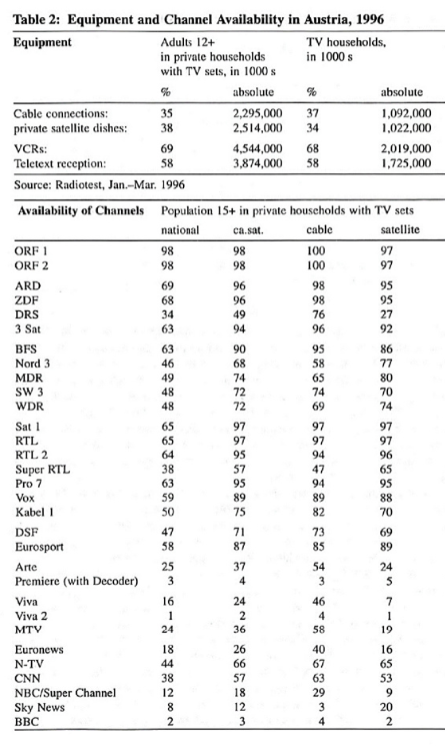
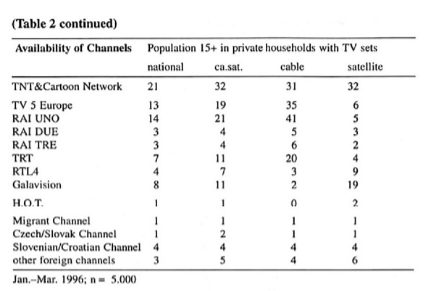
dule has been able to increase its share from 44% to 48%; see Table 2. This was chiefly made possible by extending broadcasting hours from 18 to 24 per channel and by introducing competitive programming in the afternoon and early evening. Schiejok täglich is an engaging talk show scheduled at 4 p. m. five days a week. Welcome Austria is the title of a completely new form of Teatime Television which follows the format of Breakfast TV, but has the ad-vantage that people are not rushing to leave their house but are coming home during the period it is being broadcast, between 5 p.m. and 7 p. m. Both pro-grams have almost doubled the shares of previous programs in those time pe-riods.
Program makers in ORF are assisted by the systems Program Atlas and Program Compass, both designed by GMF. The former is a description of po-tential audiences for no less than 180 program types. The latter comprises hundreds of demographics of all important programs screened during the pre-vious year. This report enables the ORF planning department to set goals for all time slots and days of the week which are to be achieved by program de-partments. On the other hand, looking into the past, GMF is attempting to set up a system of performance indicators. For individual television programs these rely on ratings (or share), appreciation, cost efficiency and a rather re-cent development on ‚relevance‘. This last term refers to the traces left in public opinion by an ORF program (or its contribution to national and popular culture) as operationalized through journalistic consensus in the research de-partment with consideration of the different functions of different genres in a national broadcaster’s television offerings. In its striving for recognition of its public mission, the ORF is able to make good use of such indicators. Radio Research
Quantitative Radio Surveys
Unlike television, radio research as yet does not allow the exact circumscrip-tion of an individual program’s acceptance on a continuous basis. It is possi-ble to establish a very detailed picture of program offerings of a week or two by running a radio diary with individual programs listed and 15-minute or even 5-minute intervals added. But the number of stations presently on the air in most markets, costs, and methodological considerations (e. g. problems with panel recruitment and fatigue, frequent over-reporting by paper diary users) makes it very difficult to continue every week of the year. On the other hand, radio is used on a more habitual basis than television. This justifies reli-ance on a more general form of research. Although some countries still use diaries and employ face-to-face interviewing, a growing number of broadcas-ters have changed over to telephone-based research. France, Israel, Italy, Nor-way, Portugal, Russia, Sweden, and Spain are examples. Also in Austria, cost considerations but likewise speed, sample recency, high response rates and high reliability have led to the change from face-to-face to radio ratings re-search by phone. For the Radiotest, Fessel+GfK is conducting 24,000 inter-views per year (around 70 per day). The duration of each of these interviews is about 20 minutes. The questionnaire soon to be computerized contains six activity/location codes per quarter hour before asking the respondent for his/her radio contact. In other words, the interview starts with radio activities just after getting up in the morning and continues for every 15 minute interval thereafter, including establishment of what had been done at what location be-fore determination of what radio station had been listened to in that particular time slot.
The high accuracy of this method has made it possible to fuse the data set into Austria’s official Media Analysis (N = 15, 500) so as to establish a ‚gold standard of radio research to which private radio companies also have access (a model similarly used in Switzerland). After attention to radio use and pre-ference for particular consumer items, the phone interview ends with ques-tions on electronics equipment in the home such as the computer, modem, and subscription to online services ‚advanced media becoming increasingly im-portant as competitors or partners of broadcast media. From the Radiotest we know that today no less than 26% of Austrians 10 years and older have access to a personal computer, and a little over 2% already use online services.
The next step in quantitative radio research most likely will involve instal-lation of the radio meter. Among competing systems, the Swiss Radio Control seems to have the best chances of success. Its basic conception has been field-tested by scientists of the Technical University of Zürich. The results of these tests were presented in GEAR meetings and suggest that the meter is techni-cally feasible even though it may seem utopian to extract split second sound samples from the air, store them in a watch and compare these patterns in the research center with the original sound tracks of all stations on air in the respective market. There is much expertise and financial support by the Swiss watch industry backing this project. In one to two years from now it is ex-pected Radio Control will be in operation probably a little faster than its competitors who are relying on self-scanning watches or pager-type devices which pick up coded audio frequencies coupled to regular radio signals.
The Qualitative Approach in Radio Research
As mentioned above, qualitative results are mostly achieved by short-term diary procedures. Two to four weeks of radio diary are a costly venture but highly informative, especially for culture and/or information-oriented radio channels. A recent study of this type was a four-week paper diary mailed to respondents in two waves. It was designed to analyze the audience of Öster-reich 1 the Austrian national up-market culture-information classical mu sic station. Although programs were rated according to their quantitative con tact, emphasis was placed on appreciation scores and also on what we call ‚attention index‘: panelists were asked to indicate whether they had followed a program with great attention or only as a form of background programming. Thus, it could be established that listening to a high-quality station such as Österreich 1 (5% daily reach) was of a totally different quality than listenning to pop music or family-oriented programs. In practice, four weeks of diary re-search make it possible to describe all relevant program types in detail.
A completely different approach is the Phonotest. This instrument helps us to determine the musical taste of a specific target group on a continuous basis. Up to 18 so-called ‚hooks‘ (20-second samples) of any musical style are being digitalized by our research partner Integral and stored on the hard disk of a personal computer. From there, the samples are transmitted in random or der via copper cable into a telephone receiver while conducting an interview with a target group respondent. Again, a scale of 0-10 is used to determine the acceptance of the musical sample while the „burn-out of the piece is de-fined as the proportion of respondents no longer wanting to hear it on air. With the help of a data bank, containing hundreds of songs, the over-all musi-cal taste of the core audience of a station can be determined and its perfor mance controlled. But also for advertizing research (pretesting of radio spots) or moderator control the Radiotest is well suited. Most recently, continuous music testing by telephone has been supplemented by what is known as ‚mu-sic mapping‘. With the help of face-to-face interviews a sufficient number of music samples is being field-tested and evaluated by multivariate analysis in order to render ‚music clusters within the audience of a station. With the help of such studies, radio formats can be neatly separated so markets among competitors with maximum efficiency, to divide local
Some Results of Radio Research
Austria is practically the last country in Europe which does not have a com pletely open market for private radio. While in the field of television almost
70% of homes are able to receive two dozen programs in German (albeit no private programs originates in Austria) in only two out of nine provinces has private local radio been established. Due to legal problems it will take about two years before commercial radio stations will be operating all over the country. This particular situation must be considered when examining radio research results. ORF produces four very distinct types of programs.
First, Österreich I may be described as a mixture of classical music, infor-mation and culture. Due to its rich supply of background information it achieves a relatively high share of the audience4%. O2 is the common name for nine provincial racio stations, each of which caters to the tastes of its regional population with an emphasis on the older age groups. The music played is mostly in German and has a high proportion of folk music. Regional news and service informatior are important parts of the program. The result is a dominant position with a weekday share of 49% nationwide, with regional shares ranging from 37% in Vienna to 65% in Burgenland. 03 is the pop radio of ORF. While under heavy competition in Styria and Salzburg, it com mands a national share of 38%. Blue Danube Radio, the English language. middle-of-the-road music station which shares its frequencies with teenage station FM4 (after 18.00 hrs.) has a listening share of 2% whereas all other (private Austrian, private foreign and public-service foreign) stations com-bined have a 9% share of the total listening time.
Outlook
Austria’s radio and television landscape is presently undergoing more change than that found in other European countries. The delayed introduction of pri vate radio and satellite television aimed specially at the Austrian advertizing. market coincides with the rapid introduction of new transmission and presen-tation techniques (from digital compression to the Internet, from CD-ROM to Intercast and other ’new media‘). In this period of transition sometimes near impossible tasks are expected of media research, such as the survey of poten-tial users of video-on-demand and pay-per-view. On the other hand, new methods are constantly being developed, such as the PC Meter Service of-fered by the NPD Group in Port Washington, New York, which measures the exposure of individuals to Internet pages by a special computer panel. GMF monitors these worldwide trends with great attention and, likewise, gladly shares its knowledge with colleagues abroad.
Note
1. The manuscript of this study was ‚rediscovered in 1988 and not published until re cently. See Desmond, M. (ed.) (1996) Paul Lazarsfeld’s Wiener RAVAG-Studie 1932, Vienna: Guthmann/Peterson, Vienna., 1996.